

.svg)

Why The HOPE Approach® Works: Turning Compassion into Action
Editor's Note: Image updated on 9/16/2026
Length of reading time: 4 minutes
When a student notices a friend is struggling, they often want to help—but they aren’t always sure what to do next.
However, when students are equipped with the confidence and skills to recognize a concern, start a conversation, and connect a peer to help, they become a critical link to support. These are gatekeeper skills: The practical tools that help someone recognize when a person may be struggling, respond with care, and connect them with appropriate support.
Empowering students with these skills can turn moments of worrying “I think something might be wrong” into a confident response of “I know what to do next.”
The HOPE Approach® is a memorable framework that equips students with gatekeeper skills they can use every day. Rather than asking students to memorize warning signs or complex protocols, The HOPE Approach® empowers them with four clear steps:
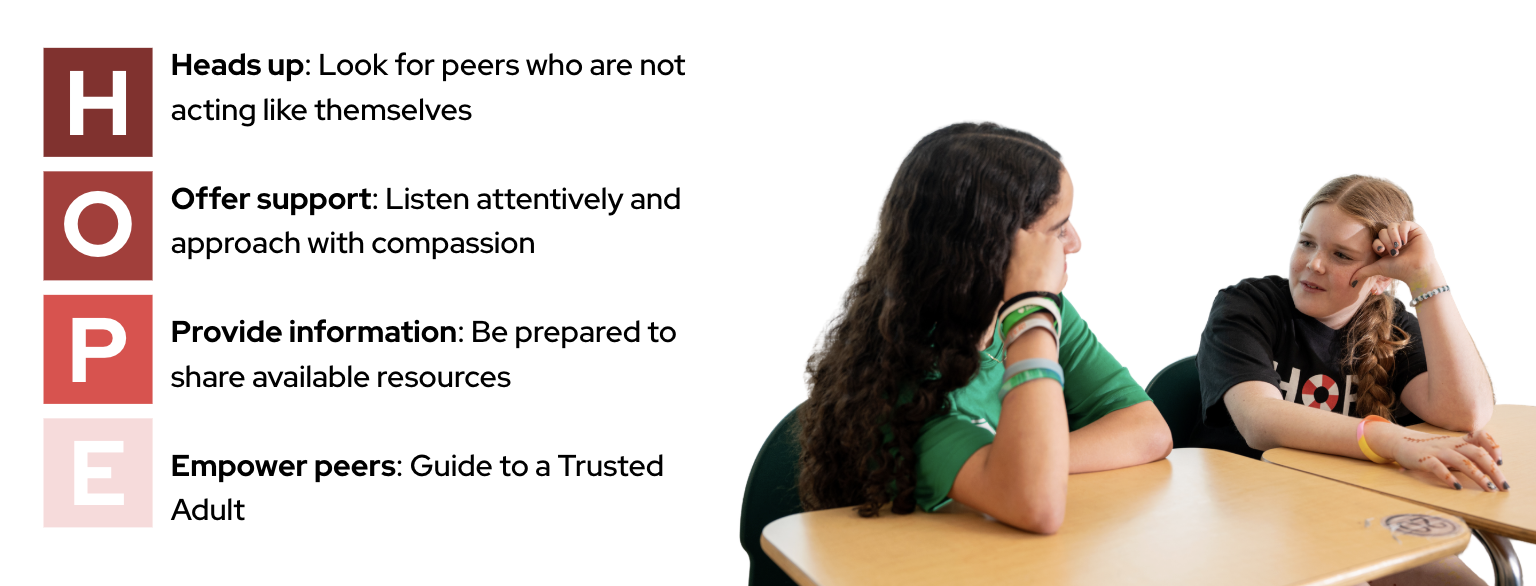
Every element of The HOPE Approach® was thoughtfully developed and reviewed by leading suicidologists to ensure students receive evidence-informed gatekeeper training through a framework that's simple enough to remember and practical enough to use.
Hope Squad Members learn and practice The HOPE Approach® repeatedly throughout the curriculum in lessons and activities. Through the Looking Out for Each Other schoolwide lesson, junior high and high school students are also introduced to the framework, creating a common language that extends beyond Hope Squad meetings.
The result is more than gatekeeper training; it's a shared culture where students recognize concerns, respond with care, and help connect one another to trusted adults.
The HOPE Approach® is more than an acronym—it's a framework students remember, practice, and apply. Read on to learn why it resonates with both students and Advisors:
Because it’s simple
The best frameworks aren't the most complicated; they're the ones students can recall when they need it most.
The HOPE Approach® breaks helping a friend into four manageable actions, giving students more confidence and less uncertainty when they notice someone may be struggling.
Advisors praised its clarity and accessibility in their responses to the 2025-2026 Hope Squad Advisor survey:
“The HOPE Approach® gatekeeper training is valuable and easy to comprehend and apply.”
Another Advisor shared:
“It is more direct and simplified. My students loved it, and I have been hearing them talk about it outside our meetings, which is great!”
When students continue discussing the framework beyond Hope Squad meetings, it becomes more than a lesson—it becomes part of how they care for one another every day.
Because it’s reinforced
Students don't build confidence through a single lesson. They build it through repeated practice.
That’s why The HOPE Approach® is intentionally woven throughout the Hope Squad curriculum, giving Members repeated opportunities to revisit, practice, and strengthen these essential skills.
On the survey, another Advisor noted:
“The program does a nice job of incorporating The HOPE Approach® into multiple lessons and encouraging members to continue to revisit and use the strategies.”
This spiraled approach–revisiting and building on previously learned skills and concepts at increasing levels of depth and complexity—helps students move beyond simply remembering the acronym to applying it with confidence.
Because everyone speaks the same language
Supporting a friend starts with knowing what to say. The HOPE Approach® gives students a shared vocabulary that makes those conversations feel less intimidating.
Another survey respondent shared:
“I have been approached by three students this past semester, and I had the verbiage and training to truly help them—I am so grateful for that training.”
When students, Advisors, and school staff all share the same language, recognizing and responding to concerns becomes more consistent, approachable, and effective.
Because it builds connection before crisis
The strongest suicide prevention efforts begin long before a crisis occurs. It happens when you create communities where students notice, support, and care for one another every day.
While The HOPE Approach® prepares students to respond when someone is struggling, its impact extends far beyond moments of crisis. It encourages students to notice one another, build meaningful relationships, and create a school culture where reaching out is normal and asking for help is encouraged.
As one Advisor noted:
“I appreciate that The HOPE Approach® helps our overall student body connect and encourage one another to take care of and look out for each other.”
That’s what makes The HOPE Approach® different. It doesn’t simply prepare students for emergencies—it helps build a community where students look out for one another every day, creating stronger connections long before a crisis occurs.
The HOPE Approach®: Building a culture of care
When students notice a friend is struggling, they shouldn't have to wonder what to do next. The HOPE Approach® gives them a clear path forward. By providing simple actions, reinforcing them over time, and creating a shared language across the school community, Hope Squad transforms compassion into confident action—and builds a culture where no student has to struggle alone.
Because when students know what to do, they're more likely to step forward—and that can make all the difference.
Share


%201.png)