

.svg)

Early Lessons in Hope: Hope Squad’s Elementary Programming
At Hope Squad, we focus on equipping students with the skills they need to protect their mental and emotional well-being. While many assume this kind of work starts in middle or high school, research shows that mental health challenges often emerge much earlier.
Why start in elementary?
A 2023 study found that 15.1% of preadolescents experience suicidal thoughts1, while school psychologists estimate that about 6.5% of children under 13 engage in self-harm, with the average onset being just above age 10.2 This data suggests that waiting until students are older to intervene may miss a critical window for prevention.
How Hope Squad helps
Hope Squad addresses this need with programming designed to support students in developmentally appropriate ways, because when it comes to mental health, it is never too early—or too late—to start the conversation and build lasting skills for life.
Recently, a parent shared a moving moment that demonstrates just how impactful Hope Squad programming can be—even among our youngest audiences:
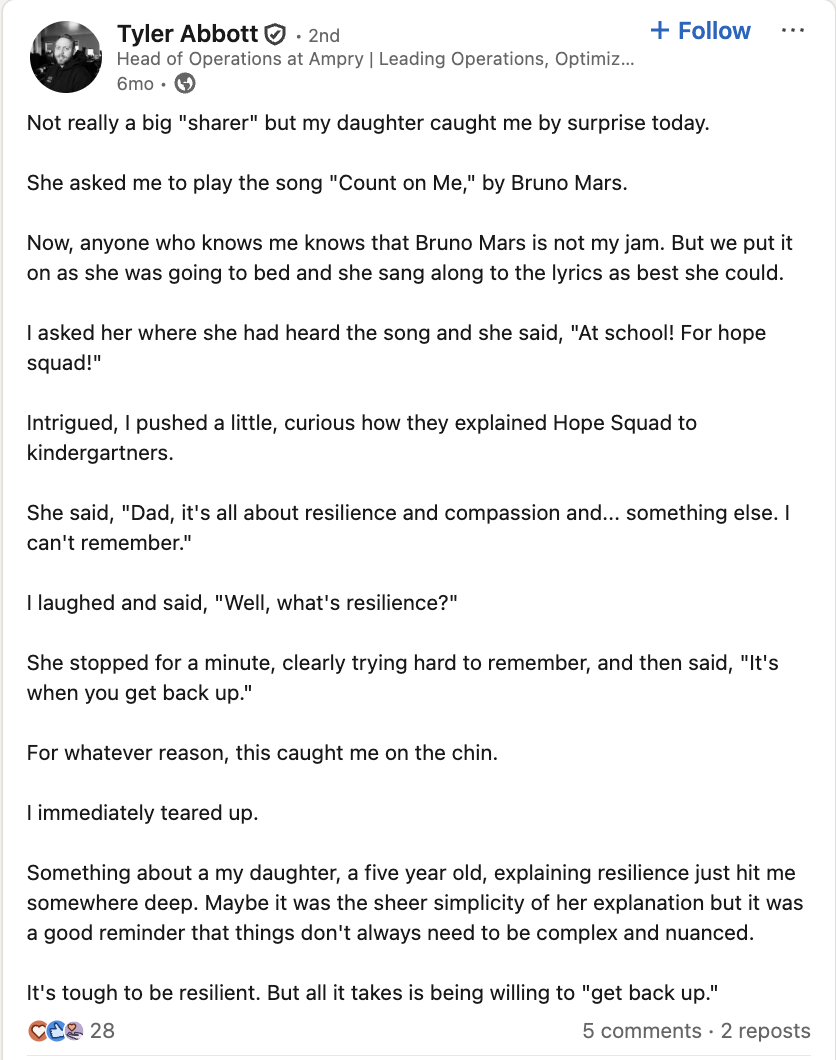
This is what Hope Squad is about. As Tyler’s story demonstrates, even our youngest students can understand concepts like resilience and compassion:
“Something about my daughter, a five-year-old, explaining resilience just hit me somewhere deep...it was a good reminder that things don’t always need to be complex and nuanced.”
Tyler’s daughter helps us understand that elementary students are already observing their worlds and are ready to notice, connect, and care—and that’s what Hope Squad empowers them to do.
The HOPE Approach
Through the HOPE approach—Heads Up, Offer Support, Provide Help, and Empower Peers —children learn to notice changes, listen with empathy, and seek help from adults. This practical, age-appropriate gatekeeper knowledge builds important help-seeking behaviors, reinforces anti-bullying practices, and creates a culture of compassion from the earliest grades.
Building a foundation for life
Hope Squad’s elementary programming not only equips students with practical skills to face challenges themselves but also instills the empathy and courage to support others. Every act of kindness, every word of encouragement, and every moment of connection builds a foundation for a lifetime of resilience and hope.
Starting these conversations in elementary school ensures that mental wellness becomes a natural part of a child’s growth. It’s never too soon to talk about feelings, coping skills, and connection, as these lessons equip children with tools they need both now and in the future.
When students know they can rely on others and reach out for help, we’re not just creating safer schools—we're nurturing communities where everyone has the tools to thrive.
----
1 Pan, B. A., Guan, K., Tang, S., Zhang, Y., Li, Z., & Lin, X. (2023). Prevalence of self-injurious thoughts and behaviors among preadolescent children: A meta-analysis.JAMA Psychiatry, 80(6), 552–561. https://doi.org/10.1001/jamapsychiatry.2023.0665
2 Townsend, E., Gage, S., Armstrong, M., & Grenyer, B. F. S. (2022). Understanding self-harm in children under 13: A survey of school psychologists.School Psychology International, 43(2), 162–178. https://doi.org/10.1177/0143034321109494
Share


%201.png)